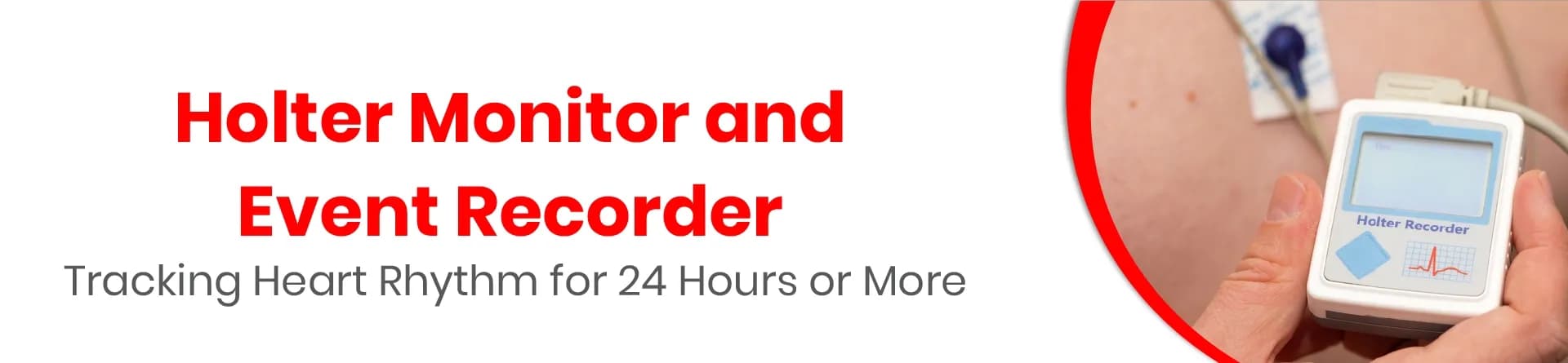
A Holter monitor continuously records your heart's electrical activity, usually for 24–48 hours, to detect irregular heartbeats that may not appear during a routine ECG.
An event recorder monitors heart rhythm over a longer period to capture occasional episodes of abnormal heartbeats.
Both devices help doctors investigate symptoms such as palpitations, dizziness, fainting and unexplained fatigue.
They can help detect heart rhythm problems such as atrial fibrillation, bradycardia, tachycardia and premature heartbeats.
The choice of monitoring device depends on how frequently symptoms occur and the type of heart rhythm problem suspected.
An irregular heartbeat does not always occur when you visit a doctor. Sometimes, changes in heart rhythm happen briefly during the day or night and may go unnoticed during a routine ECG. A Holter monitor helps detect these changes by continuously recording your heart's electrical activity for 24–48 hours or longer. An event recorder works in a similar way but is generally used for a longer period to capture occasional episodes of abnormal heart rhythm.
Both devices help doctors understand how your heart behaves during everyday activities, including walking, sleeping and exercising. They are particularly useful when you experience symptoms such as palpitations, dizziness or unexplained fainting that may not appear during a regular ECG.
A Holter monitor is a small, portable device that continuously records the electrical activity of your heart. It is commonly used to identify irregular heartbeats that may not be detected during a routine ECG.
Unlike a standard ECG, which records your heart rhythm for a short period, a Holter heart monitor tracks your heartbeat throughout the monitoring period, usually 24–48 hours. Some newer devices can record for longer.
The device generally includes:
The Holter device is usually worn around the neck, attached to a belt or carried in a pocket, depending on its design.
While wearing it, you can continue most of your usual daily activities. The device records your heart rhythm continuously, helping doctors identify changes that may occur during physical activity, rest or sleep.
An event recorder is another portable device used to monitor the heart's electrical activity. However, unlike a traditional Holter monitor, it is generally designed to capture occasional episodes of abnormal heart rhythm over a longer period, which may range from several days to a few weeks.
Some event recorders require you to press a button when you experience symptoms such as palpitations or dizziness. Others can automatically detect and record abnormal heart rhythms.
The main difference between a Holter monitor and an event recorder is how long and when they record your heart activity.
|
Feature |
Holter Monitor |
Event Recorder |
|
Monitoring period |
Usually 24–48 hours; sometimes longer |
Usually several days to weeks |
|
Recording method |
Continuously records heart rhythm |
Records selected episodes or automatically detected events, depending on the device |
|
Best suited for |
Frequent or daily symptoms |
Occasional symptoms that may not occur every day |
|
Patient involvement |
Usually no manual activation needed |
Some devices require you to activate the recording |
|
Main purpose |
Identify frequent rhythm changes |
Capture less frequent episodes of abnormal heart rhythm |
Your cardiologist will recommend the appropriate device based on how often you experience symptoms and how frequently an abnormal heartbeat is suspected.
Doctors may recommend a Holter test for heart evaluation when a routine ECG does not explain symptoms that could be related to an abnormal heart rhythm.
These tests are particularly useful when symptoms occur intermittently and are difficult to capture during a hospital or clinic visit.
Your doctor may recommend Holter monitoring or an event recorder if you experience:
Doctors may also recommend monitoring to check whether treatment for an existing heart rhythm condition is working or to assess how a pacemaker is functioning.
Holter monitoring helps doctors identify different types of abnormal heart rhythms, also known as arrhythmias. It records electrical signals from the heart over an extended period, making it easier to detect rhythm changes that may happen occasionally.
Some heart rhythm problems that may be identified include:
Holter monitoring can also help doctors understand whether symptoms such as dizziness or palpitations occur at the same time as an abnormal heart rhythm.
However, it does not detect every heart condition. For example, it cannot reliably rule out blocked heart arteries or diagnose every cause of chest pain.
A Holter test cardiology procedure is simple and usually does not require hospital admission. You can generally go home shortly after the device is attached.
Here is what you can expect:
A healthcare professional may clean your chest and remove excess hair from the areas where the electrodes will be placed. This helps the adhesive patches stay in position and maintain good contact with your skin.
Small electrodes are placed on your chest and connected to the Holter monitoring machine. The recording unit is then attached to your clothing or carried in a small pouch.
You can usually continue your normal routine while wearing the device. Your doctor may ask you to follow your usual daily activities so that the recording reflects your regular heart rhythm.
You may be asked to note the time when you experience palpitations, dizziness, chest discomfort or other symptoms. You should also record activities such as exercise, sleep and medication timings if instructed.
This helps doctors compare your symptoms with the heart rhythm recorded by the device.
Once the monitoring period is complete, you return the device to the healthcare facility. The recorded information is downloaded and analysed by a specialist.
A few precautions can help ensure accurate recordings:
Most people can sleep normally while wearing the device. Your healthcare team will explain how to manage it during sleep and other daily activities.
Once monitoring is complete, the recorded data is analysed by a cardiologist or a trained specialist.
The report provides information about your heart rate, rhythm patterns and any unusual electrical activity detected during the monitoring period.
Doctors generally look at:
For example, if you report dizziness at a particular time, the cardiologist can check whether your heart rate slowed down or an abnormal rhythm occurred during that period.
If no abnormal rhythm is detected, it does not always mean that your heart rhythm is normal at all times. The suspected episode may not have occurred during the monitoring period. Your doctor may recommend longer monitoring or another test if symptoms continue.
The findings help determine whether you need further investigations, medication adjustments or other treatment.
A regular ECG records your heart's electrical activity for a few seconds or minutes during a medical visit. A Holter monitor continuously records your heart rhythm for 24–48 hours or longer. This makes it more useful for identifying irregular heartbeats that occur occasionally during everyday activities.
Yes. A Holter monitor can detect several types of irregular heart rhythms, including atrial fibrillation, tachycardia, bradycardia and premature heartbeats. It can also help doctors identify when these changes occur and whether they are linked to your symptoms.
No. Wearing a Holter monitor is generally painless. The electrodes are attached to your chest using adhesive patches. Some people may experience mild skin irritation or discomfort when the patches are removed.
Yes. You can usually sleep normally while wearing a Holter monitor. However, you should position the recording unit safely and avoid pulling or disconnecting the wires while sleeping.
Most traditional Holter monitors are not waterproof, so you should avoid showering, bathing or swimming while wearing them. Some newer devices may be water-resistant. Always follow the instructions provided by your healthcare team.
Avoid getting the device wet, removing the electrodes or exposing the recording unit to conditions that may interfere with its functioning. Follow your doctor's instructions about electronic devices and physical activities. You should also avoid changing your usual medicines unless advised.
A Holter monitor is primarily designed to identify abnormal heart rhythms, not diagnose a heart attack. Although it may record certain electrical changes, it cannot reliably confirm or rule out a heart attack. Suspected heart attack symptoms require immediate medical attention, usually involving an ECG and blood tests such as troponin.
Written and Verified by:

Dr. Anil Mishra is the Director of Cardiology Dept. at BM Birla Heart Hospital, Kolkata. He specializes in complex angioplasties, pacemaker & AICD implantation, CRT-D, TAVI, and was the first in Eastern India to perform rotablation and implant leadless pacemakers.
Similar Cardiology Blogs
Book Your Appointment TODAY
© 2024 BMB Kolkata. All Rights Reserved.


