
Breast cancer is the most common cancer among women in India.
The National Cancer Registry Programme estimated about 2.39 lakh new breast cancer cases among Indian women in 2025. Source
Surgery is an important part of breast cancer treatment. Depending on the cancer, you may have a lumpectomy or mastectomy. A lumpectomy removes the tumour and some nearby healthy tissue. A mastectomy removes the whole breast.
The right choice depends on the size and location of the tumour, the type and stage of breast cancer, your overall health and whether radiation therapy is suitable for you.
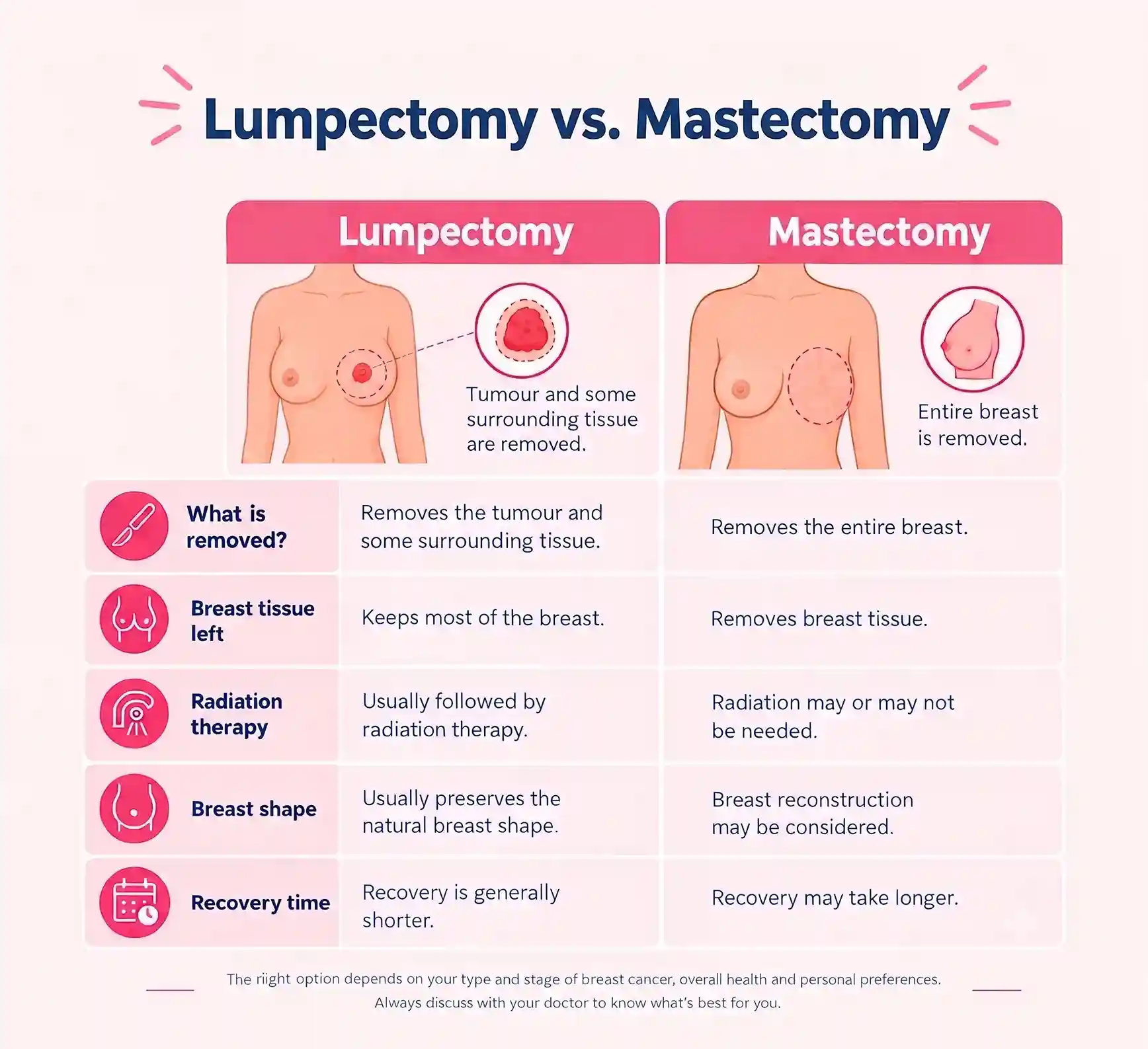
The main difference between lumpectomy and mastectomy is how much breast tissue is removed.
A lumpectomy, also called breast-conserving surgery, removes the breast tumour along with a small margin of healthy tissue around it. Most of the breast is left in place. You may also hear it called partial mastectomy.
A mastectomy removes the entire breast. There are different types of mastectomy, and the type you need depends on the cancer and your treatment plan. Breast reconstruction may be done during the same surgery or at a later time.
|
Lumpectomy |
Mastectomy |
|
Removes the tumour and some surrounding tissue |
Removes the entire breast |
|
Keeps most of the breast |
Removes breast tissue |
|
Usually followed by radiation therapy |
Radiation may or may not be needed. |
|
Usually preserves the natural breast shape |
Breast reconstruction may be considered. |
|
Recovery is generally shorter. |
Recovery may take longer. |
For some people with early-stage breast cancer, lumpectomy followed by radiation therapy and mastectomy can provide similar long-term survival. Therefore, removing the whole breast does not automatically mean better cancer control.
Lumpectomy may be recommended when the cancer can be removed while keeping most of the breast. Your doctor may consider a lumpectomy when:
After a lumpectomy, radiation therapy is commonly recommended. It helps destroy cancer cells that may remain in the breast and lowers the risk of the cancer coming back. However, not everyone needs radiation, so your cancer team will decide based on factors such as your age, cancer type and overall health.
One benefit of breast-conserving surgery is that you keep most of your breast tissue. However, the breast may look slightly different after surgery, depending on the size and location of the tumour.
Sometimes, cancer cells are found at the edge of the removed tissue. This is called a positive or involved surgical margin. You may need another surgery to remove more tissue and achieve clear margins.
A mastectomy removes the whole breast. It may be recommended when breast-conserving surgery is not suitable or when removing the entire breast is considered appropriate based on your cancer.
Your doctor may recommend a mastectomy when:
Breast reconstruction is still possible after a mastectomy. Some people choose reconstruction during the same operation, while others have it later. You can also choose not to have reconstruction.
For many people with early-stage breast cancer, lumpectomy followed by radiation therapy can offer survival outcomes similar to those of mastectomy.
The choice of surgery is therefore not based on survival alone. Doctors also consider the tumour's size and location, whether clear margins can be achieved, the need for radiation therapy, genetic risk and your personal preferences.
However, these results do not apply to every type or stage of breast cancer. Some cancers may require mastectomy because of their size, spread within the breast or other clinical factors.
It is also important to understand that local recurrence can differ between the two approaches. Breast-conserving surgery leaves some breast tissue behind, so cancer can return in the treated breast. Radiation therapy helps reduce this risk.
Recovery after lumpectomy is usually shorter because less tissue is removed. You may have some pain, swelling or bruising around the surgical area. Your doctor will tell you when you can return to normal activities.
Mastectomy is a larger operation, so recovery may take longer. You may have a surgical drain for some time after the procedure. Recovery can also take longer if you have breast reconstruction at the same time.
Radiation therapy is commonly given after lumpectomy. After mastectomy, you may not need radiation therapy in some cases. However, it may still be recommended when there is a higher risk of the cancer returning, such as when the tumour is large or cancer has spread to the lymph nodes.
After mastectomy, you may choose breast reconstruction using an implant or your own tissue. It can be done during the mastectomy or later.
Reconstruction is usually not needed after a standard lumpectomy. However, some breast-conserving procedures may include reshaping the breast to improve its appearance.
There is no single surgery that is right for every person with breast cancer. Your doctor will look at several factors before recommending breast cancer surgery. These may include:
Your surgeon and oncology team will explain the benefits and possible risks of each option. You can ask how each surgery may affect your recovery, breast appearance, radiation therapy and follow-up care.
The main difference between lumpectomy and mastectomy is how much breast tissue is removed. Lumpectomy removes the tumour while keeping most of the breast, whereas mastectomy removes the entire breast.
For some early-stage breast cancers, both approaches can provide similar long-term survival. However, they are not suitable for everyone. The right option depends on the type and stage of your cancer, the size and location of the tumour, whether you can receive radiation therapy, your genetic risk and your personal preferences.
Talk to your breast surgeon and oncology team about both options before making a decision. They can explain which procedures are suitable for your cancer and what to expect during treatment and recovery.
Lumpectomy and mastectomy can both be effective for certain breast cancers. The right choice depends on the size and location of your tumour, cancer stage, need for radiation therapy, genetic risk and personal preferences.
Discuss both options with your breast surgeon and oncology team to understand which surgery is suitable for you.
For many people with early-stage breast cancer, lumpectomy followed by radiation and mastectomy can offer similar long-term survival.
Yes. Breast cancer can come back in the treated breast after lumpectomy. Radiation therapy and other treatments can help reduce this risk.
Radiation therapy is commonly recommended after lumpectomy, but it may not be needed for everyone. Your doctor will decide based on your age, cancer type and other factors.
Both can be effective for many early-stage breast cancers. The choice depends on the tumour, your treatment needs and whether radiation therapy is suitable
For many early-stage breast cancers, mastectomy has not been shown to provide better long-term survival than lumpectomy followed by appropriate radiation therapy.
Sometimes. Radiation is not needed after every mastectomy, but it may be recommended when there is a higher risk of the cancer returning.
It can. The breast may look slightly different after lumpectomy, depending on the tumour's size, location and amount of tissue removed.
Yes. The type and stage of breast cancer, along with tumour size, location, genetic risk and other factors, can affect which surgery is recommended.
Written and Verified by:

Dr. Anand Mohan is a leading Surgical Oncologist in Rajasthan, known for managing complex oncological cases.
Similar Oncology Blogs
Book Your Appointment TODAY
© 2024 RBH Jaipur. All Rights Reserved.


