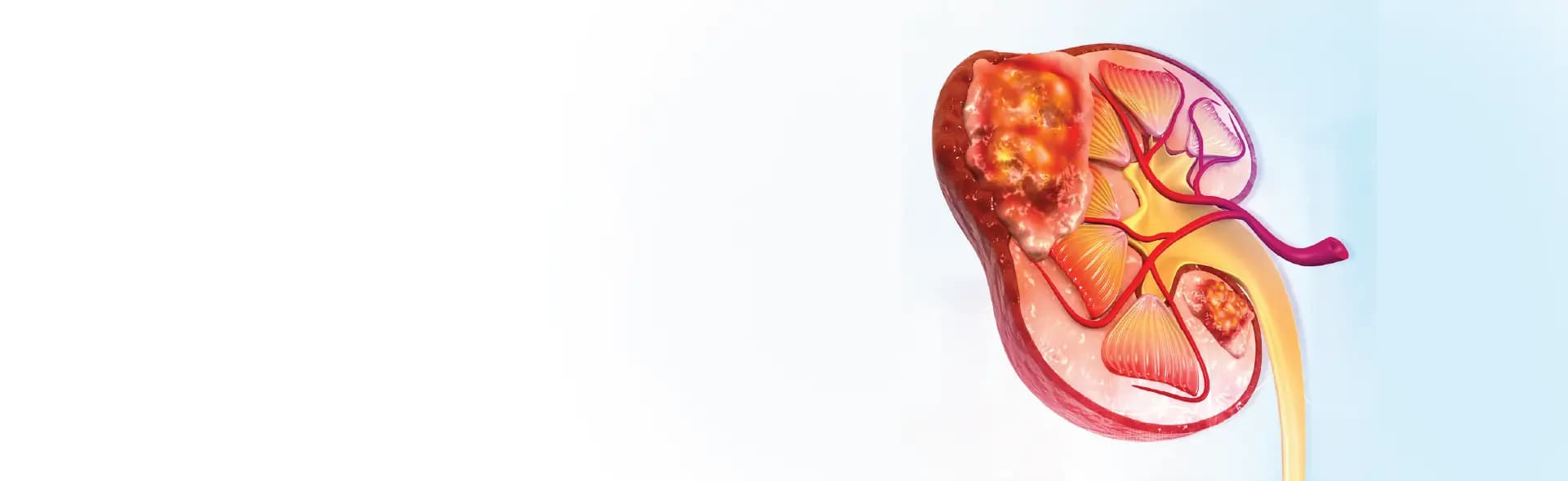
Kidney cancer (renal cancer) develops when cancer cells multiply and form a tumour in your kidney. Common symptoms include blood in your urine, pain in your side or back and unexplained weight loss. Kidney cancer treatment may include surgery, ablation, immunotherapy and targeted therapy, depending on the stage of cancer and your overall health.
At the CK Birla Hospitals, Jaipur, you can consult our specialists to understand your diagnosis and discuss suitable treatment options.
Kidney cancer occurs when abnormal cells grow uncontrollably in your kidneys and form a tumour. The most common type is renal cell carcinoma (RCC), which begins in the cells lining the small tubes inside your kidneys.
The exact kidney cancer causes are not always known. However, certain factors can increase your risk of developing the condition.
Kidney cancer risk factors include:
Age: The risk of kidney cancer increases as you get older.
Smoking: Smoking increases your risk of developing kidney cancer.
Obesity: Excess body weight is associated with a higher risk.
High blood pressure: High blood pressure is linked to an increased risk of kidney cancer.
Family history: Having a close family member with kidney cancer may increase your risk.
Inherited conditions: Certain genetic conditions, such as von Hippel-Lindau disease, can increase your risk.
Long-term dialysis: Long-term dialysis may increase the risk of kidney cancer.
Having these risk factors does not mean you will develop kidney cancer.

Kidney cancer may not cause noticeable symptoms in its early stages. Some people discover it during an imaging test performed for another health condition.
As the tumour grows, symptoms may include:
Blood in your urine, which may appear pink, red or brown.
Pain in your side or back, below the ribs.
A lump or swelling in your side or abdomen.
Unexplained weight loss.
Loss of appetite.
Persistent tiredness or fatigue.
Fever that keeps coming back without a clear cause.
These symptoms can also occur due to other health conditions. If you notice blood in your urine or persistent pain in your side, consult a doctor for an assessment.
A doctor will review your symptoms and medical history before recommending tests. These tests help identify a kidney tumour, assess its size and location, and determine whether the cancer has spread.
Tests used to diagnose kidney cancer include:
Blood tests: These tests assess kidney function and check for changes in blood cell levels.
Urine tests: These tests can detect blood or other abnormalities in your urine.
Imaging tests: Ultrasound, CT scans and MRI scans help identify a kidney tumour and assess its size and location.
Biopsy: In selected cases, a doctor may take a small tissue sample to check for cancer cells. A biopsy is not necessary in every case.
If the tests confirm kidney cancer, your doctor will determine its stage to help plan treatment.
There are four main stages of kidney cancer.
|
Stage |
Tumour location |
|
Stage 1 |
The tumour is small and confined to the kidney. |
|
Stage 2 |
The tumour is larger but remains within the kidney. |
|
Stage 3 |
The cancer has spread to nearby lymph nodes, major blood vessels or surrounding tissues. |
|
Stage 4 |
The cancer has spread to nearby structures beyond the kidney or to distant organs, such as the lungs, liver or bones. |
Kidney cancer treatment depends on the stage of cancer, the size and location of the tumour, your overall health and how well your kidneys function. Your doctor may recommend one treatment or a combination of treatments.
Active surveillance may be suitable for some small kidney tumours that are unlikely to cause immediate harm. Your doctor will monitor the tumour through regular imaging tests and follow-up appointments. Treatment may be recommended if the tumour grows or changes.
Surgery to remove part or all of the affected kidney is a common treatment for kidney cancer. Surgical options include:
Partial nephrectomy: The surgeon removes the tumour and a small amount of surrounding kidney tissue. This helps preserve as much healthy kidney tissue as possible.
Radical nephrectomy: The surgeon removes the entire affected kidney. Nearby tissues, adrenal glands or lymph nodes may also be removed when necessary.
The type of surgery depends on the size and location of the tumour and whether the cancer has spread.
Ablation uses heat or cold to destroy cancer cells. It may be recommended for selected small kidney tumours, particularly when surgery is not suitable.
The main types include:
Cryoablation: This treatment uses extreme cold to freeze and destroy cancer cells.
Radiofrequency ablation: This treatment uses an electric current to heat and destroy cancer cells.
Immunotherapy uses medicines that help your immune system recognise and attack cancer cells. It may be recommended for advanced kidney cancer or cancer that has spread to other parts of the body.
Your doctor may recommend immunotherapy alone or in combination with other medicines.
Targeted therapy uses medicines that act on specific proteins or processes involved in cancer growth. Some medicines block the formation of blood vessels that supply the tumour, while others target processes that help cancer cells grow.
These medicines may be used for advanced kidney cancer or in selected cases after surgery.
Radiation therapy uses high-energy radiation to destroy cancer cells or control their growth. It is not usually the main treatment for kidney cancer confined to the kidney. However, it may help relieve symptoms when cancer has spread to other parts of the body, such as the bones.
Surgery may be recommended when a kidney tumour is cancerous and can be removed. It is often the main treatment when the cancer has not spread beyond the kidney. Your doctor may recommend surgery when:
The tumour is confined to the kidney and can be removed.
The tumour's size or location requires surgical treatment.
Removing the tumour may help control the disease.
The cancer has spread locally and surgery is considered appropriate as part of the treatment plan.
For smaller tumours, partial nephrectomy may help preserve kidney function. Larger or more complex tumours may require radical nephrectomy.
Surgery may also be considered in selected cases of advanced kidney cancer. If the cancer has spread to distant organs, immunotherapy or targeted therapy may be needed as part of the treatment plan.
Your doctor will explain the procedure, possible risks and expected recovery time before surgery.
Kidney cancer treatment requires an accurate diagnosis and a treatment plan based on the stage of the disease. At the CK Birla Hospitals, Jaipur, you can consult our specialists to understand your condition and discuss suitable treatment options.
Diagnosis and assessment: Our specialists review your symptoms, medical history and test results.
Treatment options: We help you understand suitable treatment options based on your diagnosis and overall health.
Surgical treatment: When surgery is recommended, our team explains the procedure and expected recovery.
Advanced cancer care: We help you understand treatment options when kidney cancer has spread to other parts of the body.
Follow-up care: We guide you through follow-up appointments and monitoring after treatment.
If you have symptoms of kidney cancer or have been diagnosed with a kidney tumour, consult a specialist to discuss the next steps.
Yes, kidney cancer can be detected early. However, it may not cause symptoms in its initial stages. Some cases are discovered during imaging tests performed for other reasons. Early diagnosis can help doctors plan suitable treatment.
No, not every kidney tumour is cancerous. Some kidney tumours are benign, which means they do not spread to other parts of the body. Imaging tests and, in selected cases, a biopsy can help determine the nature of the tumour.
Yes, many people can live a healthy life with one functioning kidney. The remaining kidney can usually perform enough of the body's filtering functions. Your doctor may recommend regular checks of kidney function and blood pressure.
Kidney cancer may continue to grow and spread to nearby tissues or distant organs if left untreated. This can make treatment more complex and may cause additional complications. The rate of progression varies, so your doctor can explain the risks based on your diagnosis.
Yes, kidney cancer can spread to other parts of the body. It may affect nearby lymph nodes or spread to organs such as the lungs, liver and bones. This is called metastasis. Treatment depends on where the cancer has spread and your overall health.
A kidney tumour is an abnormal growth of cells in the kidney. It may be benign or cancerous. Kidney cancer refers to a malignant tumour that can grow into nearby tissues and spread to other parts of the body.
© 2024 RBH Jaipur. All Rights Reserved.


