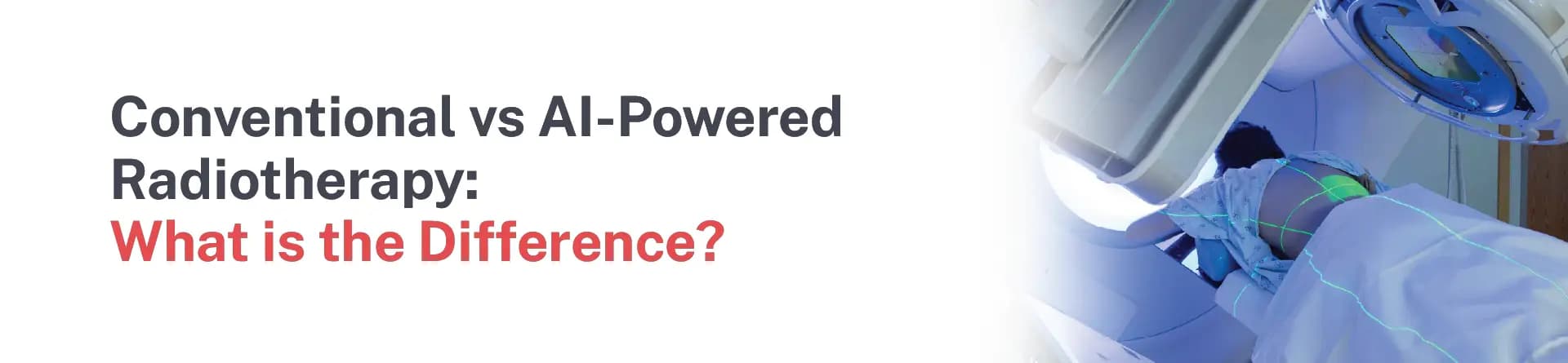
Radiotherapy is an important treatment for many types of cancer. It uses high-energy radiation to damage cancer cells and stop them from growing. Modern radiotherapy has become more precise with technologies such as image guidance, intensity-modulated radiation therapy (IMRT), and volumetric modulated arc therapy (VMAT).
Now, AI-powered radiotherapy can add another level of precision to treatment planning and delivery. Artificial intelligence (AI) can help analyse images, outline tumours and organs at risk, create treatment plans, and adapt radiation delivery when the patient's anatomy changes.
So, what is the difference between conventional and AI-powered radiotherapy? The main difference is how technology supports treatment planning and adaptation. Conventional radiotherapy generally uses a treatment plan created before the treatment course begins, although adjustments may be made when needed. AI-assisted systems can analyse new images and help the radiation team adjust the plan when needed.
In conventional radiotherapy, the radiation oncologist and treatment planning team create a detailed plan using scans taken before treatment begins. The plan determines how much radiation should be given, from which angles, and how nearby organs can be protected.
The same basic plan may then be used throughout the treatment course, while image guidance and other checks help ensure accurate delivery.
AI-powered radiotherapy uses artificial intelligence to support several steps of this process. AI can analyse medical images, identify and outline structures, assist with dose calculations, and help create or adjust treatment plans.
One important development is adaptive radiotherapy. In this approach, new images can be taken during the treatment course or immediately before a session. If the tumour has changed in size or shape, or nearby organs have moved, the treatment plan can be adjusted to match the patient's current anatomy.
In simple terms:
|
Feature |
Conventional Radiotherapy |
AI-Assisted Radiotherapy |
|
Treatment planning |
Planned before treatment |
AI can support planning and optimisation. |
|
Image analysis |
Mainly performed by the clinical team and software |
AI can assist with image analysis. |
|
Tumour/organ outlining |
Manual or software-assisted |
AI can automate or speed up contouring. |
|
Changes during treatment |
May require a revised plan |
AI can help identify changes and support adaptation. |
|
Doctor's role |
Essential |
Essential |
AI does not replace the radiation oncologist. The treatment team remains responsible for reviewing the plan and making clinical decisions.
AI in radiotherapy can be used at different stages of the treatment process.
AI can analyse CT, MRI and other medical images. It can help identify and outline the tumour and nearby organs that need to be protected.
Creating a radiation plan involves deciding how radiation should reach the tumour while limiting exposure to healthy tissue. AI can analyse large amounts of information and help generate or optimise treatment plans more efficiently.
Before radiation is delivered, specialists need to outline the tumour and organs at risk. AI-based tools can help automate this process and reduce the time required for treatment planning.
AI can support adaptive treatment by analysing new images and helping the team determine whether the existing plan still fits the patient's anatomy.
For example, a tumour may shrink during treatment, or organs may change position because of normal body movement. AI-assisted adaptive systems can help create a plan that reflects these changes.
Researchers are also studying AI models that can predict treatment response and the risk of certain side effects. However, these applications still require clinical validation before they can be widely relied upon.
Both conventional and AI-assisted radiotherapy can deliver highly precise radiation. The main difference is that AI can add more automation, image analysis and adaptation to the treatment workflow.
This does not mean AI makes every radiotherapy treatment better or that every patient needs adaptive treatment. The appropriate approach depends on the type of cancer, tumour location, treatment goal and the patient's anatomy.
It can help reduce radiation exposure to nearby healthy tissues in selected patients. The purpose of AI-assisted planning and adaptive radiotherapy is to better match the radiation dose to the tumour while protecting organs at risk.
During treatment, the anatomy can change because of tumour shrinkage, weight changes, breathing or movement of organs. Adaptive radiotherapy uses updated imaging to account for these changes.
By adjusting the treatment plan when appropriate, the radiation team may be able to reduce the dose reaching nearby healthy structures.
However, this does not mean that AI-powered radiotherapy completely prevents side effects. Radiation can still affect healthy cells, and side effects depend on the type of cancer, treatment area, radiation dose and individual patient factors.
AI-assisted radiotherapy can be considered for different cancers, but not every patient needs AI-assisted or adaptive treatment.
It may be particularly useful when the tumour or nearby organs can change position or shape during treatment. This may apply to some prostate, cervical, bladder, head and neck, and pelvic cancers.
Patients receiving highly precise treatments, such as stereotactic radiation, may also need careful management of anatomical changes.
Your radiation oncologist can decide whether conventional, image-guided, adaptive or another advanced radiotherapy technique is suitable for you.
The key difference between conventional and AI-powered radiotherapy is how technology supports treatment planning, image analysis and adaptation.
Conventional radiotherapy can already deliver precise cancer treatment. AI-assisted radiotherapy adds tools that can help analyse images, plan treatment and adjust the treatment plan when the patient's anatomy changes.
AI is a support tool for radiation oncology teams, not a replacement for doctors. Your radiation oncologist can recommend the approach that best suits your cancer and treatment needs.
AI-powered radiotherapy is not automatically better for every patient. AI can improve planning efficiency, image analysis and treatment adaptation, but its usefulness depends on the cancer type and treatment plan. Clinical decisions still require a radiation oncology team.
There is currently not enough evidence to say that AI radiotherapy directly improves cancer survival. Research has shown benefits in areas such as treatment planning, automation and workflow efficiency, but definitive improvements in survival still need to be demonstrated in clinical studies.
It may help reduce radiation exposure to some nearby healthy tissues by improving treatment planning and adaptation. This could reduce the risk of certain side effects, but it does not eliminate them. More clinical research is needed to establish the full benefit for patient outcomes.
AI used in radiotherapy is mainly designed to support image analysis, treatment planning and radiation delivery. It should not be viewed as a replacement for a radiation oncologist. The doctor reviews the patient's scans, diagnosis, medical history and treatment goals before deciding the appropriate treatment.
AI is being studied and used across different areas of radiation oncology, but it is not suitable or necessary for every cancer or every patient. Its use depends on factors such as tumour location, movement, size, treatment technique and available technology.
AI-powered radiotherapy can be used safely when it is properly validated and integrated into clinical workflows with appropriate checks. AI tools still require clinical oversight because errors in imaging, contouring or treatment planning can affect patient care. Current research also highlights the need for validation, data quality, privacy and human oversight.
Written and Verified by:

Additional Director Exp: 14 Yr
Radiation Oncology & Radiosurgery
Dr. Ruchir Bhandari is a highly experienced Clinical Oncologist with over 14 years of expertise in advanced cancer care.
Similar Oncology Blogs
Book Your Appointment TODAY
© 2024 RBH Jaipur. All Rights Reserved.


