
Pancreatic cancer starts when abnormal cells grow in the pancreas, an organ that helps with digestion and controls blood sugar. It may not cause clear symptoms in the early stages. Treatment depends on the size and location of the tumour, whether it has spread and whether it can be safely removed with surgery.
The pancreas is located behind your stomach. It makes digestive enzymes and hormones such as insulin. Pancreatic cancer can develop in different parts of the pancreas and may grow into nearby tissues or blood vessels as it progresses. Some early symptoms can be easy to miss. These may include:
Your doctor may recommend blood tests and imaging to look for a pancreatic tumour. Tests may include a CT scan, MRI, PET scan or endoscopic ultrasound (EUS). A biopsy may be needed to confirm the diagnosis.
Your doctor may also recommend genetic or biomarker testing to help identify treatment options for some patients.
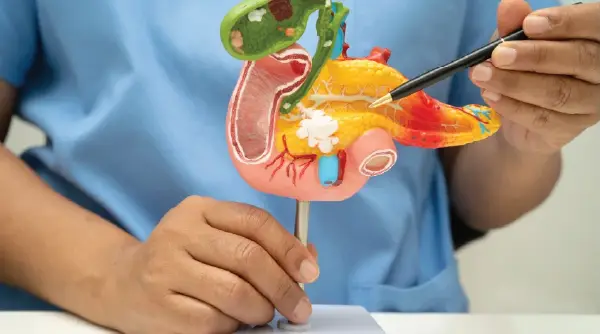
Surgery may be considered when the cancer can be completely removed. The type of surgery depends on where the tumour is located.
Chemotherapy uses medicines to kill cancer cells or slow their growth. It may be given before surgery to shrink the tumour or after surgery to destroy cancer cells that may remain.
For advanced pancreatic cancer, chemotherapy may be the main treatment when surgery is not possible.
Radiation therapy uses high-energy radiation to target cancer cells. It may be combined with chemotherapy before or after surgery in selected patients.
Radiation therapy may also be considered when the cancer cannot be removed or when it is needed to help control symptoms.
Some pancreatic cancers have specific genetic or molecular changes. Testing can help your doctor understand whether targeted medicines or other specialised treatments may be suitable.
These treatments are not appropriate for every patient. Your doctor will consider your test results, cancer type and stage before recommending them.
Doctors may also describe pancreatic cancer based on whether it can be removed with surgery. This is called resectability.
|
Type |
What it means |
Common treatment approach |
|
Resectable |
The tumour can potentially be removed completely. |
Surgery may be combined with chemotherapy before or after surgery. |
|
Borderline resectable |
The tumour is close to nearby blood vessels but may still be removable. |
Chemotherapy, with or without radiation, may be given before surgery. |
|
Locally advanced |
The cancer has grown around major blood vessels and cannot currently be removed safely. |
Chemotherapy is usually used, with radiation considered in selected cases. |
|
Metastatic |
The cancer has spread to distant organs. |
Treatment mainly focuses on controlling the cancer and managing symptoms. |
These treatment groups broadly correspond to different stages of pancreatic cancer. However, the treatment plan is based on more than the stage alone. Your tumour's location, blood vessel involvement, overall health and response to treatment also matter.
For stage 4 pancreatic cancer treatment, the cancer has spread to distant parts of the body. Surgery to remove the primary tumour is usually not possible. Treatment may include chemotherapy and, in selected cases, targeted treatment or radiation therapy to control the cancer or relieve symptoms.
Surgery is considered when your doctor believes the tumour can be removed completely and safely. The Whipple procedure is mainly used for tumours in the head of the pancreas.
Some patients with borderline resectable cancer may first receive chemotherapy, with or without radiation therapy. Your doctors may then repeat scans to see if surgery is possible.
Not every pancreatic cancer patient needs surgery. When the cancer has spread to distant organs or cannot be safely removed, medicines and other treatments may be used instead.
See a doctor if you have symptoms such as unexplained weight loss, persistent upper abdominal or back pain, jaundice, loss of appetite, repeated nausea or changes in your bowel movements.
These symptoms can happen because of many conditions and do not always mean pancreatic cancer. However, persistent or unexplained symptoms should be checked.
If pancreatic cancer is suspected, your doctor may refer you to a gastroenterologist, oncologist or pancreatic surgeon for further tests and treatment planning.
At the CK Birla Hospitals, Jaipur, we plan pancreatic cancer treatment based on your diagnosis, tumour location, stage and overall health.
Your care may involve specialists from different areas, including surgical oncology, medical oncology, radiation oncology, gastroenterology, radiology and nutrition. Working together helps your team decide whether surgery, chemotherapy, radiation therapy or a combination of treatments is appropriate for you.
We also focus on supportive care during treatment. This may include help with nutrition, pain and other treatment-related symptoms.
Our team explains your diagnosis and treatment options clearly so that you know what to expect at each step of your care.
Early pancreatic cancer may not cause noticeable symptoms. Possible warning signs include unexplained weight loss, loss of appetite, upper abdominal or back pain and jaundice. Persistent symptoms should be evaluated by a doctor.
The Whipple procedure is a major surgery used mainly for pancreatic tumours located in the head of the pancreas. It involves removing the head of the pancreas and nearby parts of the digestive system, along with nearby lymph nodes.
No. Surgery is mainly considered when the tumour can be completely removed. If the cancer has spread or cannot be safely removed, chemotherapy, radiation therapy or other treatments may be recommended instead.
Your nutritional needs may change during treatment. You may need enough calories, protein and fluids to maintain your strength. If surgery affects pancreatic enzyme production, your doctor may recommend pancreatic enzyme replacement. A dietitian can help plan meals based on your treatment and symptoms.
Recovery depends on the type of surgery and your overall health. Pancreatic surgery is a major procedure, so recovery can take several weeks. Your surgeon will explain your expected hospital stay, diet changes and activity restrictions based on the procedure you have.
© 2024 RBH Jaipur. All Rights Reserved.


