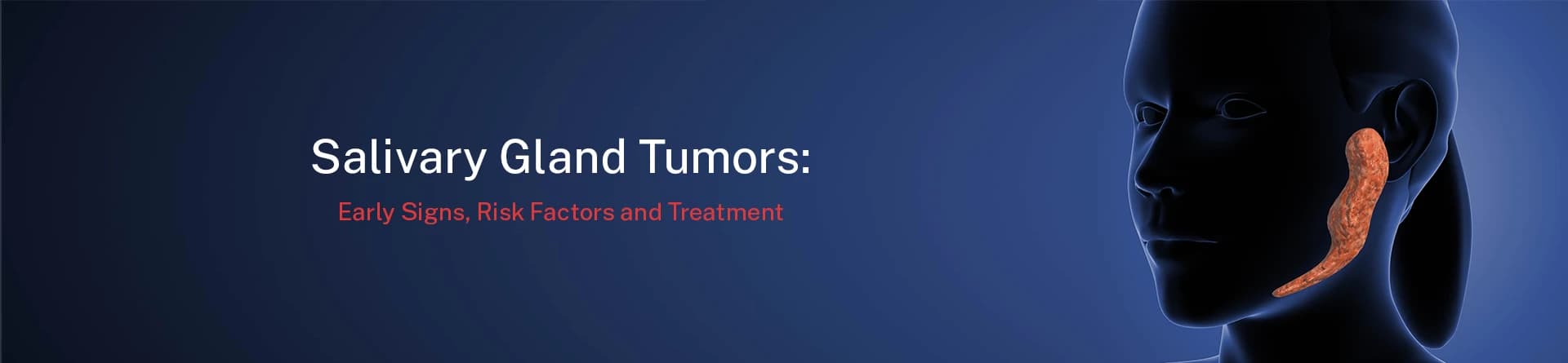
Salivary gland tumours are abnormal growths that develop in the glands responsible for producing saliva. While many of these tumours are benign (non-cancerous), such as pleomorphic adenomas, others can be malignant (cancerous) and require immediate medical intervention. Because these glands are located near critical structures like the facial nerves, early detection is vital for successful treatment.
Key Highlights from the Blog:
Have you noticed a small, painless lump near your jaw or ear? Or maybe a swelling in your mouth that doesn’t seem to go away? At first, it may not feel serious. Many people ignore these signs, thinking it’s just a minor issue. But sometimes, these can be early signs of salivary gland tumours.
Salivary gland tumours develop in the glands that produce saliva, the fluid that keeps your mouth moist and helps with digestion. While many of these tumours are not cancerous, some can turn into salivary gland cancer, which needs timely treatment. Understanding the early symptoms, risk factors, and treatment options can help you take the right steps at the right time.
Salivary gland tumours are abnormal growths that form in your salivary glands. These glands are located in and around your mouth and throat. You have three major pairs of salivary glands:
There are also many small glands inside your mouth. These tumours can be:
The most common benign salivary gland tumour is called a pleomorphic adenoma. On the other hand, malignant salivary gland tumours are less common but more serious. It’s important to know that not all salivary gland tumours are cancer, but all unusual lumps should be checked by a doctor.
In many cases, the first symptoms of salivary gland cancer are mild and easy to ignore. That’s why awareness is important.
These are often the first signs of salivary gland tumours.
These are considered more serious salivary gland cancer symptoms, especially if they persist. In many Indian households, people tend to ignore small lumps or swelling, thinking it’s temporary. But if a lump does not go away within 2–3 weeks, it’s best to consult a Otolaryngologist in Kolkata.
Doctors don’t always know the exact cause of salivary gland cancer. However, certain factors can increase the risk.
It’s important to remember that having these risk factors does not mean you will definitely develop salivary gland tumours. It just increases the chances.
If you notice symptoms, a doctor will perform a few tests to find out what’s causing the problem.
The treatment depends on:
Surgery is the most common salivary gland tumour treatment.
Doctors take special care to protect the facial nerves during surgery.
Radiation uses high-energy rays to destroy cancer cells.
It is often used.
Chemotherapy uses medicines to kill cancer cells.
It is usually used when:
This is a newer treatment that targets specific cancer cells without harming normal cells.
Salivary gland tumours may be rare, but they should not be ignored. A painless lump might seem harmless, but it can be an early sign of a bigger problem.
The good news is that with early diagnosis and proper treatment, many people recover well.
If you or someone in your family notices any unusual swelling near the jaw, ear, or mouth, it’s always better to get it checked early. A small step today can prevent bigger problems tomorrow.
No, most salivary gland tumours are benign (non-cancerous), especially those in the parotid gland.
Yes, a painless lump near the jaw or ear can be a sign of a salivary gland tumour and should be checked by a doctor.
Surgery is the most common treatment, but not all cases require it, especially if the tumour is small or benign.
It depends on the type—benign tumours usually grow slowly over years, while malignant ones may grow faster.
Yes, some tumours can come back after treatment, so regular follow-up with your doctor is important.
Yes, imaging tests like ultrasound, CT scan, or MRI can help detect tumours early and guide diagnosis.
Written and Verified by:

Dr. Dhiraj Ranjan Sarkar is a Consultant Surgeon in ENT Dept. at CMRI, Kolkata with over 18 years of experience. He specializes in ear microsurgeries, FESS & nasal surgeries, microlaryngeal procedures, tonsillectomy, thyroid & parotid surgeries.
Similar ENT- Otolaryngology Blogs
Book Your Appointment TODAY
© 2024 CMRI Kolkata. All Rights Reserved.


