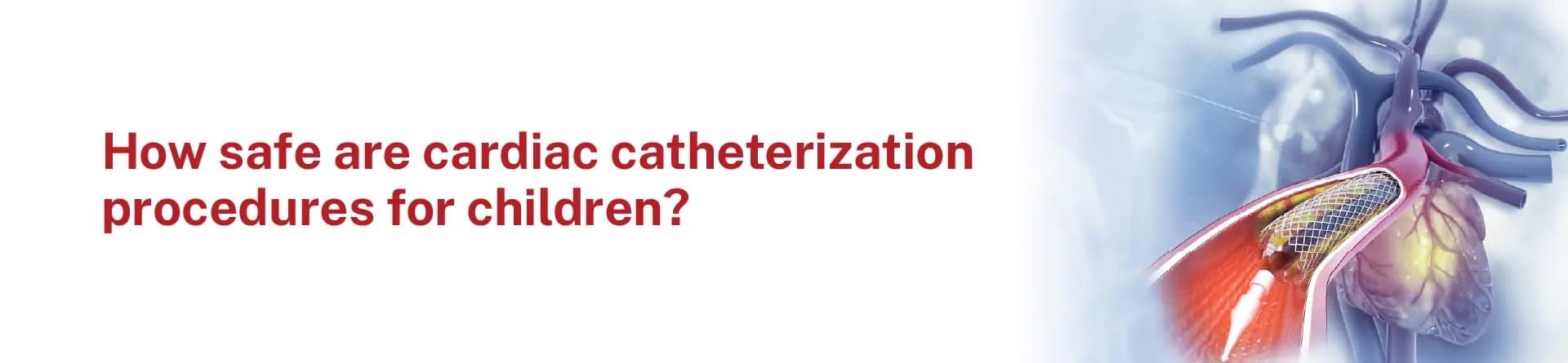
Is cardiac catheterisation safe for children? Yes — this advanced heart procedure helps detect and correct structural heart problems with minimal pain, short recovery time, and rare complications under expert care.
When a child is diagnosed with a heart problem, parents naturally feel scared and confused. One test or treatment that doctors often suggest is cardiac catheterisation. Many parents immediately worry: Is it safe? Will my child feel pain? Are there risks?
This blog will answer all your queries. We will explain what cardiac catheterisation is, why it is done, how safe it is for children, possible risks, and when parents should contact a doctor after the procedure.
Cardiac catheterisation is a medical procedure that helps doctors check and treat heart problems. In this procedure, a thin and soft tube called a catheter is gently passed into a blood vessel. This is usually done through the leg (near the groin) or sometimes the arm. The catheter is slowly guided to the heart.
So, what is cardiac catheterisation used for? Doctors use this cardiac catheterisation test to:
In many children, heart problems are present from birth, which are called congenital heart defects. Cardiac catheterisation enables doctors to understand the root cause of the problem.
Sometimes, cardiac catheterisation is not only used to diagnose a heart condition but also as a treatment. It may be used to:
This procedure reduces the need for open-heart surgery. This is why many parents hear the term cardiac catheterisation surgery, even though it is not a major surgery that involves opening the chest.
One of the most important questions parents ask is, 'How safe is cardiac catheterisation in child patients?'
The good news is that cardiac catheterisation is safe for children, even newborn babies. With modern technology and trained paediatric cardiologists, the success rate is very high.
In India and across the world, thousands of children undergo this procedure every year. Most of them recover well and return to normal activities in a short time. The success of the procedure depends on several factors, including:
Like any medical procedure, cardiac catheterisation has some risks. However, serious cardiac catheterisation complications are rare, especially in children.
Some possible risks include:
In very rare cases, more serious problems like damage to blood vessels or heart structures can occur. Doctors are trained to handle such situations quickly.
It is important to understand that most children experience no major complications and recover smoothly.
Doctors take many steps to make cardiac catheterisation as safe as possible for children.
Here’s how risks are reduced:
Before the procedure, doctors carefully study the child’s reports. They also explain everything to parents and answer their questions.
Because of these safety measures, cardiac catheterisation has become much safer today than in the past.
Most children recover quickly after cardiac catheterisation. Some may go home the same day, while others stay in the hospital for one or two days.
However, parents should contact a doctor if they notice:
These signs do not always mean a serious problem, but it is better to seek medical advice early.
For many parents, hearing the words 'cardiac catheterisation' in 'child' can be frightening. But understanding the procedure helps reduce fear.
Today, cardiac catheterisation is a safe and effective procedure that helps doctors diagnose and treat heart problems in children. With experienced doctors, modern equipment, and proper care, most children do very well.
If your doctor has advised a cardiac catheterisation procedure for your child, do not hesitate to ask questions. Knowing what to expect can give you confidence and peace of mind. Your child’s heart is in safe hands.
No. Children are given medicines to sleep or relax, so they do not feel pain during the procedure. Mild soreness may be felt later.
It usually takes about 1 to 2 hours, but it may take longer if treatment is also done.
Most children, especially small kids, are given general anaesthesia or deep sedation to keep them comfortable and still.
Many children go home the same day or the next day, depending on the procedure and recovery.
Some heart defects can be fully corrected, while others may improve but need follow-up care or future treatment.
It can be safely done at any age, even in newborn babies, when performed by experienced paediatric heart doctors.
Written and Verified by:

Dr. Madhurima Ghosh specializes in complex congenital cardiac malformations and trans-catheter cardiac interventions in children. Awarded the Presidential Gold Medal in Paediatric Cardiology and certified by Sick Kids, Toronto.
Similar Pediatric Cardiology Blogs
Book Your Appointment TODAY
© 2024 BMB Kolkata. All Rights Reserved.