Most benign tumours are non-cancerous and harmless, but some can grow, cause symptoms, or affect nearby organs. This blog explains the causes, symptoms, diagnosis, treatment options, and when a non-cancerous lump requires medical attention.
Have you noticed a lump under your skin and wondered if it could be cancer? It's a common concern. The good news is that not every lump is cancerous. In fact, many are benign tumours—non-cancerous growths that do not spread to other parts of the body.
However, that doesn't mean every non-cancerous lump should be ignored. Some benign tumours can continue to grow, press on nearby organs or nerves, cause pain, or affect how your body functions. In some cases, they may even require treatment or surgery.
So, how do you know whether a lump is harmless or needs medical attention?
In this blog, we'll explain what benign tumours are, their causes, symptoms, common types, treatment options, and the warning signs that mean it's time to see a doctor.
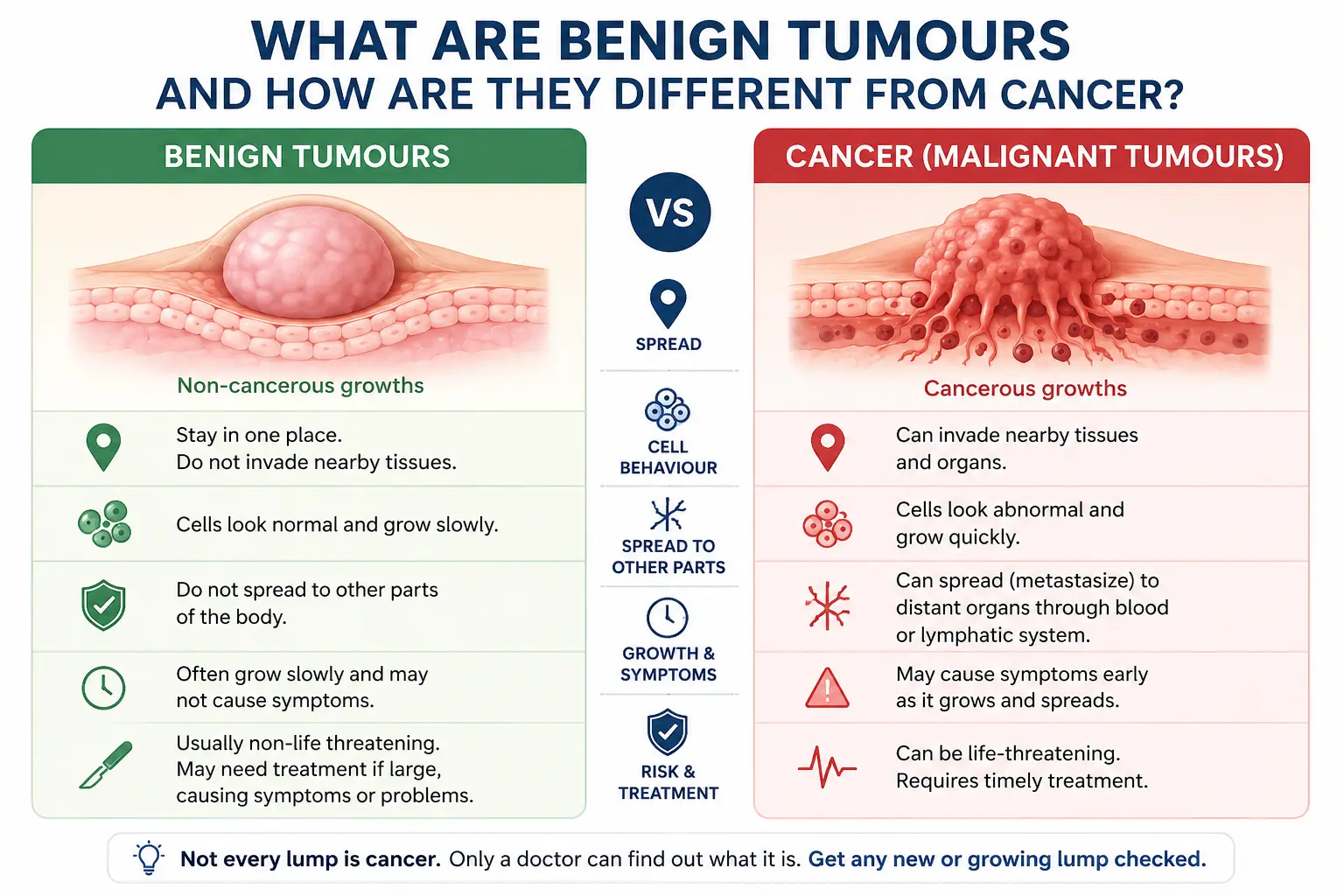
A benign tumour is an abnormal growth of cells that is not cancerous. Unlike malignant (cancerous) tumours, benign tumours stay in one place and do not spread to distant parts of the body through the blood or lymphatic system.
Many benign tumours grow slowly and may never cause any problems. Some are discovered during a routine health check-up or during an imaging scan performed for another reason.
"Is a benign tumour cancer?" is a common question, and the answer is no. A benign tumour is not cancer. However, every new or growing lump should be examined by a doctor because only a medical evaluation can confirm whether it is benign or malignant.
The biggest difference between a benign tumour and a cancerous tumour is how they behave.
A benign tumour usually grows slowly and remains confined to one area. Cancerous tumours, on the other hand, can invade nearby tissues and spread to other parts of the body.
Here's a simple comparison.
|
Benign Tumor |
Cancerous Tumor |
|
Non-cancerous |
Cancerous |
|
Usually grows slowly |
May grow quickly |
|
Does not spread to other organs |
Can spread to distant parts of the body |
|
Often has smooth, well-defined borders |
May have irregular borders and invade nearby tissues |
|
May only need monitoring |
Often requires more extensive treatment |
While benign tumours are generally less serious, their location can make a big difference. For example, a benign tumour in the brain may still require treatment because it can press on important structures.
The exact benign tumour causes are not always known. In many cases, there is no single reason why they develop.
Some factors that may increase the risk include:
Most people who develop a benign tumour have no obvious risk factors.
There are many types of benign tumours, and they can develop almost anywhere in the body. Some common examples include:
Each type behaves differently, which is why a medical evaluation is important.
Many benign tumours cause no symptoms, especially when they are small. They are often found by chance during a scan or physical examination. When symptoms do occur, they usually depend on the tumour's size and location.
Common benign tumour symptoms include:
A lump that continues to grow or causes discomfort should always be assessed by a doctor.
Although many benign tumours never need treatment, some should not be ignored.
See a doctor if you notice:
These signs do not always mean cancer, but they do require medical evaluation.
Many people ask, "Can a benign tumour become malignant?" In most cases, the answer is no. Most benign tumours remain non-cancerous throughout life.
However, a few specific types, such as certain adenomas or some colon polyps, may develop into cancer over time if left untreated. This is why doctors sometimes recommend removing them or monitoring them regularly.
Regular follow-up helps detect any concerning changes early.
If you discover a lump, your doctor will first ask about your symptoms and examine the area.
Depending on the findings, they may recommend:
A biopsy involves removing a small sample of tissue for laboratory testing. It is the most reliable way to confirm whether a lump is benign or cancerous.
Treatment depends on the tumour's type, size, location and symptoms.
In many cases, surgery completely removes the tumour and prevents future problems.
Never ignore a lump simply because it does not hurt. Book an appointment if you notice:
Early medical evaluation helps identify the cause and ensures you receive the right treatment if needed.
Finding a non-cancerous lump can be worrying, but most benign tumours are not cancer and do not spread to other parts of the body. Even so, they should never be diagnosed at home.
Understanding what a benign tumour is, recognising benign tumour symptoms, and knowing the benign tumour causes can help you decide when to seek medical advice. While many benign tumours only require observation, others may need medication or surgery depending on their size, location and symptoms.
If you notice a new lump or an existing one starts changing, do not ignore it. A timely medical evaluation can provide reassurance, identify the cause and help you receive the most appropriate care.
A cancerous mole may change in size, shape or colour, have irregular borders, itch, bleed or look different from your other moles. The ABCDE rule can help identify suspicious changes.
Yes. Around 30% of melanomas develop from existing moles, while most develop as new spots on normal-looking skin.
No. Many dark moles are harmless. However, any mole that changes in appearance or develops unusual features should be checked by a dermatologist.
Yes. Skin cancer can appear as a new spot or growth on the skin, which is why regular skin self-examinations are important.
Yes. When detected early, melanoma can often be treated successfully, usually with surgery before it has a chance to spread.
Yes. Although the risk increases with age, melanoma can also occur in younger adults and, less commonly, in teenagers.
Melanoma can spread to nearby tissues and other organs if left untreated, making early diagnosis and prompt treatment essential.
Written and Verified by:

Dr. Aseem K. Samar is a leading Medical Oncologist in Jaipur with expertise in treating solid tumors and blood cancers through advanced therapies like chemotherapy, immunotherapy, and targeted treatment. He specializes in personalized cancer care for breast, lung, gastrointestinal, and hematological cancers.
Similar Oncology Blogs
Book Your Appointment TODAY
© 2024 RBH Jaipur. All Rights Reserved.


