
Night blindness (nyctalopia) is a condition that makes it difficult to see in low-light or dark environments. It is often caused by vitamin A deficiency, cataracts, retinal disorders, or other eye conditions. Early diagnosis and treatment can help improve night vision and address the underlying cause.
Have you noticed that driving at night feels more difficult than it used to? Do you struggle to see clearly in dimly lit places or need extra time for your eyes to adjust when moving from bright areas into darkness? These could be signs of night blindness.
Despite its name, night blindness does not mean complete blindness at night. Instead, it refers to poor vision in low-light conditions. People with night blindness often have difficulty seeing after sunset, in dark rooms, or while driving at night.
Night blindness is not a disease itself. It is usually a symptom of an underlying eye condition or nutritional deficiency. According to opthalmologists, understanding the causes and symptoms can help ensure early diagnosis and appropriate treatment.
What exactly is night blindness?
Night blindness, also known as nyctalopia, is a condition that makes it difficult to see in low-light or dark environments. People with this condition may see normally during the day but have difficulty seeing in dim light or darkness.
The eyes rely on specialised cells in the retina called rod cells to help us see in low-light conditions. These cells depend on rhodopsin, a light-sensitive pigment that requires vitamin A for its production and proper function. When the retina is unable to respond to light effectively, vision in darkness becomes impaired.
One common cause of night blindness is a deficiency of essential nutrients, particularly vitamin A. This vitamin plays a critical role in maintaining healthy vision and supporting retinal function.
However, vitamin deficiency is not the only cause. Several eye diseases and medical conditions can also contribute to poor night vision.
Night blindness often develops gradually. Many people do not realise they have a problem until it begins affecting daily activities.
Common night blindness symptoms include:
There are several possible reasons why someone may develop night blindness. In many cases, difficulty seeing at night is a symptom of an underlying eye condition or nutritional deficiency rather than a condition on its own.
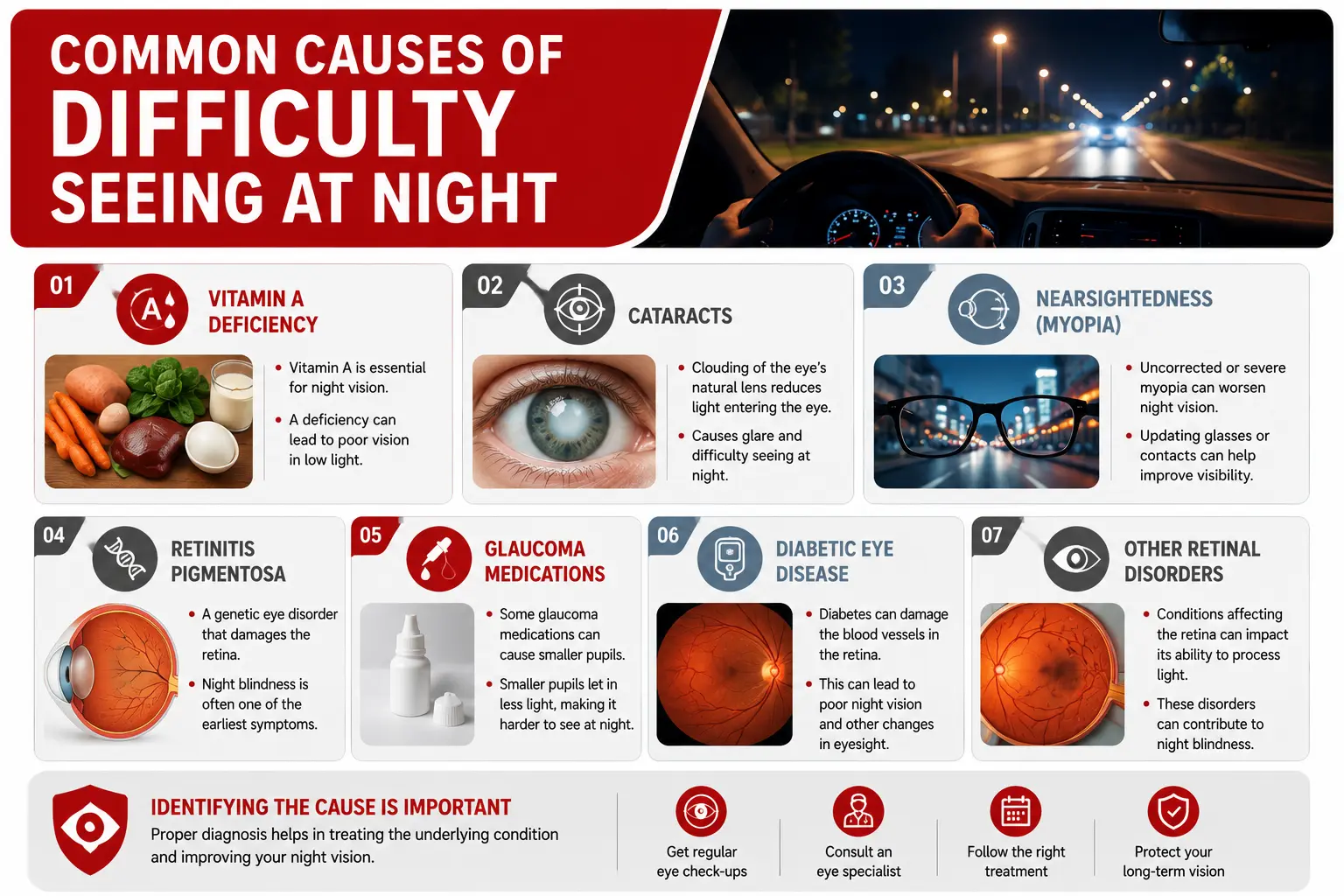
One of the most common causes of night blindness worldwide is vitamin A deficiency. Vitamin A is essential for the production of rhodopsin, a light-sensitive pigment in the retina that helps the eyes see in low-light conditions. When the body does not have enough vitamin A, the retina cannot function properly in dim light, leading to poor night vision.
Cataracts occur when the eye's natural lens becomes cloudy. This reduces the amount of light reaching the retina and can make it difficult to see clearly at night. People with cataracts may also experience glare from headlights and difficulty driving after dark.
People with uncorrected or severe myopia may notice that their vision worsens in low-light conditions. Updating glasses or contact lens prescriptions may help improve night-time vision.
Retinitis pigmentosa is an inherited eye condition that gradually damages the retina. Night blindness is often one of the earliest symptoms, and vision problems may worsen over time as the disease progresses.
Certain medications used to treat glaucoma can cause the pupils to become smaller. Smaller pupils allow less light to enter the eye, which may make it more difficult to see in dimly lit environments.
Diabetes can damage the blood vessels in the retina, leading to diabetic eye disease. As retinal damage progresses, some people may experience difficulty seeing in low-light conditions or notice changes in their overall vision.
Several other retinal conditions can affect the eye's ability to adapt to darkness and respond to light effectively. These disorders may interfere with normal retinal function and contribute to night blindness symptoms.
Understanding the underlying cause of poor night vision is important because treatment depends on identifying and addressing the specific condition responsible for the symptoms.
If you experience persistent problems with night vision, an eye examination can help determine the underlying cause. Your eye doctor may perform:
Early diagnosis is important because treatment depends on identifying the underlying cause.
There is no single treatment that works for everyone. Treatment depends on what is causing the problem.
If night blindness is caused by low vitamin A levels, dietary improvements and vitamin A supplementation may improve night vision. Foods rich in vitamin A include:
When cataracts are responsible for poor night vision, surgery to replace the cloudy lens can significantly improve eyesight.
Updating glasses or contact lens prescriptions may improve night vision for people with refractive errors.
Conditions such as retinitis pigmentosa and diabetic eye disease require specialised management to slow progression and preserve vision.
The effectiveness of treatment depends largely on identifying and addressing the underlying cause as early as possible.
Occasional difficulty seeing in very dark environments can be normal. However, you should schedule an eye examination if:
Early evaluation can help identify treatable causes before vision problems become more severe.
Night blindness is a condition that makes it difficult to see in low-light environments and is often a sign of an underlying eye problem or nutritional deficiency. While vitamin A deficiency remains one of the most common causes, conditions such as cataracts, retinal diseases, and diabetic eye disease can also contribute to poor night vision.
Recognising night blindness symptoms early and seeking professional evaluation can help identify the cause and improve outcomes. If you are experiencing persistent difficulty seeing at night, do not ignore these symptoms. An eye examination can help determine the reason behind your vision changes and guide the most appropriate treatment.
Yes. Vitamin A deficiency is one of the most common causes of night blindness because the retina requires vitamin A to produce rhodopsin, a pigment essential for vision in low-light conditions.
In some cases, yes. If the condition is caused by vitamin A deficiency, cataracts, or correctable vision problems, treatment may significantly improve night vision. Some inherited retinal diseases may not be fully reversible.
It can, depending on the underlying cause. Conditions such as retinitis pigmentosa may gradually worsen, while treatable causes can often be managed effectively.
Yes. Cataracts reduce the amount of light reaching the retina and commonly cause difficulty seeing at night.
If night blindness affects your ability to see road signs, pedestrians, or vehicles clearly, driving at night may be unsafe. Consult an eye specialist for evaluation and advice.
Written and Verified by:

Dr. Manikuntala Sengupta is a Consultant in Ophthalmology Dept. at CMRI, Kolkata, with over 36 years of experience. She specializes in complex eye surgeries, including glaucoma surgery, corneal grafting, and amniotic membrane grafting.
Similar Ophthalmology Blogs
Book Your Appointment TODAY
© 2024 CMRI Kolkata. All Rights Reserved.


