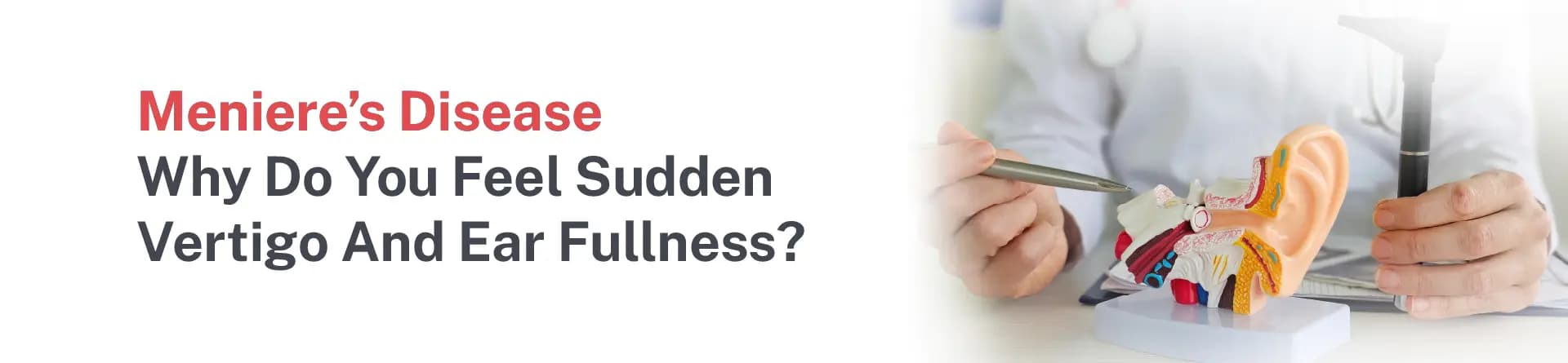
Meniere’s disease is a chronic inner ear disorder that causes sudden vertigo, ear fullness, tinnitus, and fluctuating hearing loss due to fluid buildup. These attacks can be unpredictable and may worsen over time without proper management.
Have you ever felt the room suddenly start spinning, even though you were standing still? Or experienced a strange pressure in one ear, like it’s blocked, along with ringing sounds? If this has happened more than once, you might have wondered, whatis Meniere’s disease?
Meniere’s disease is a long-term inner ear condition that affects balance and hearing. It can cause sudden vertigo attacks, ear fullness, ringing in the ear (tinnitus), and hearing problems. These episodes can feel scary and unpredictable, especially when you don’t know what’s happening.
In this blog, we’ll explain Meniere’s disease symptoms, causes, diagnosis, and Meniere’s disease treatment options in simple and easy-to-understand language.
Meniere’s disease (sometimes spelt 'menier disease') is a disorder of the inner ear. The inner ear plays a very important role in both hearing and balance. When something goes wrong there, it can affect how you hear and how steady you feel.
In people with Meniere’s disease, fluid builds up inside the inner ear. This extra fluid affects the signals sent to the brain. As a result, you may experience:
These are the main signs and symptoms of Meniere’s disease. Usually, it affects only one ear, especially in the early stages.
One of the most distressing Meniere’s disease symptoms is vertigo. Vertigo is not just dizziness. It feels like the room is spinning around you, even when you’re not moving.
So, why does this happen?
Inside your inner ear, there are tiny structures filled with fluid. These structures help control your balance. When there is too much fluid pressure, it disturbs the balance of signals being sent to your brain.
During a vertigo attack:
These sudden episodes are one of the key signs and symptoms of Meniere’s disease. They often come without warning. After the attack ends, you might feel tired or off-balance for hours or even days.
Many people ask, what causes Meniere’s disease? The exact answer is not fully known. However, experts believe that fluid buildup in the inner ear is the main problem.
Some possible Meniere’s disease causes include:
Although we don’t know exactly what causes Meniere’s disease, these factors may increase your chances of developing it.
The feeling of fullness or pressure in the ear happens because of the extra fluid. It can feel like your ear is blocked or needs to "pop", but it doesn’t go away easily.
Tinnitus is the ringing, buzzing, or humming sound you hear in your ear. In Meniere’s disease, this sound may get worse before or during a vertigo attack.
Hearing loss in Meniere’s disease often starts as temporary. Sounds may seem muffled or distorted. Over time, repeated attacks can cause permanent hearing damage in the affected ear. These symptoms together form the classic picture of Meniere’s disease symptoms.
Certain people may be more likely to develop this condition. Some Meniere’s disease risk factors include:
Even though anyone can develop Meniere’s disease, it is more common in middle-aged adults.
If you’re experiencing repeated vertigo and ear problems, you may wonder how doctors confirm it. There is no single test that proves Meniere’s disease. Doctors usually diagnose it based on your symptoms and medical history.
To diagnose the condition, a doctor may:
If you have repeated vertigo attacks, hearing changes, tinnitus, and ear fullness, your doctor may diagnose Meniere’s disease after ruling out other problems.
There is currently no permanent cure for Meniere’s disease, but there are many ways to control the symptoms. The goal of Meniere’s disease treatment is to reduce the frequency and severity of attacks.
Doctors may prescribe:
These are common approaches in Meniere’s disease management.
Many doctors recommend:
Lowering salt intake can help reduce fluid pressure in the inner ear.
Stress can trigger attacks. Managing stress through relaxation, meditation, or light exercise may help. Getting enough sleep is also important in Meniere’s disease management.
If symptoms are severe and do not improve with medication, doctors may suggest:
In rare cases, surgery may be needed if vertigo attacks are very disabling.
The right Ménière's disease treatment plan depends on how severe your symptoms are and how often they occur.
Occasional dizziness can happen for many reasons. But you should see a doctor if:
Early diagnosis can help improve Ménière's disease management and reduce long-term damage.
If vertigo is severe, sudden, and comes with symptoms like double vision, weakness, or trouble speaking, seek emergency care. These could be signs of something more serious.
Living with Meniere’s disease can be challenging because the attacks are unpredictable. You may feel anxious about when the next episode will happen. However, many people learn to manage their condition successfully.
With the right Meniere’s disease treatment, lifestyle changes, and regular medical follow-up, many patients experience fewer and less intense attacks over time.
Understanding what Meniere’s disease is helps reduce fear. When you know why vertigo and ear fullness happen, you can take steps to manage them.
Meniere’s disease is a condition that affects the inner ear, causing vertigo, ear fullness, tinnitus, and hearing loss. While we don’t fully understand what causes Meniere’s disease, fluid buildup in the inner ear is believed to play a major role.
Recognizing the signs and symptoms of Meniere’s disease early can help you seek treatment sooner. Although there is no cure yet, proper Meniere’s disease management can greatly improve your quality of life.
If you experience repeated spinning sensations or changes in your hearing, don’t ignore them. Talk to a doctor and get the right guidance. The sooner you understand your symptoms, the better you can take control of them.
Vertigo in Meniere’s disease is triggered by fluid buildup and pressure changes in the inner ear that disrupt balance signals to the brain.
People with Meniere’s disease should limit high-salt foods, caffeine, alcohol, and processed foods, as these can worsen fluid retention and symptoms.
Vertigo attacks in Meniere's disease typically last between 20 minutes and several hours and may leave you feeling tired afterward.
Yes, Meniere’s disease is a chronic (long-term) condition, but symptoms can often be managed effectively with proper treatment.
Yes, Meniere’s disease can cause fluctuating hearing loss at first, which may become permanent over time.
Unlike regular vertigo, Meniere’s disease includes additional symptoms like ear fullness, tinnitus, and hearing loss along with spinning sensations.
Written and Verified by:

Dr. Vijay Kumar Sharma is a Consultant in ENT-Otolaryngology Dept. at CK Birla Hospital, Jaipur, with over 5 years of experience. He specializes in cochlear implants, endoscopic ear surgery, head & neck surgery, and lateral skull base procedures.
Similar ENT- Otolaryngology Blogs
Book Your Appointment TODAY
© 2024 RBH Jaipur. All Rights Reserved.


