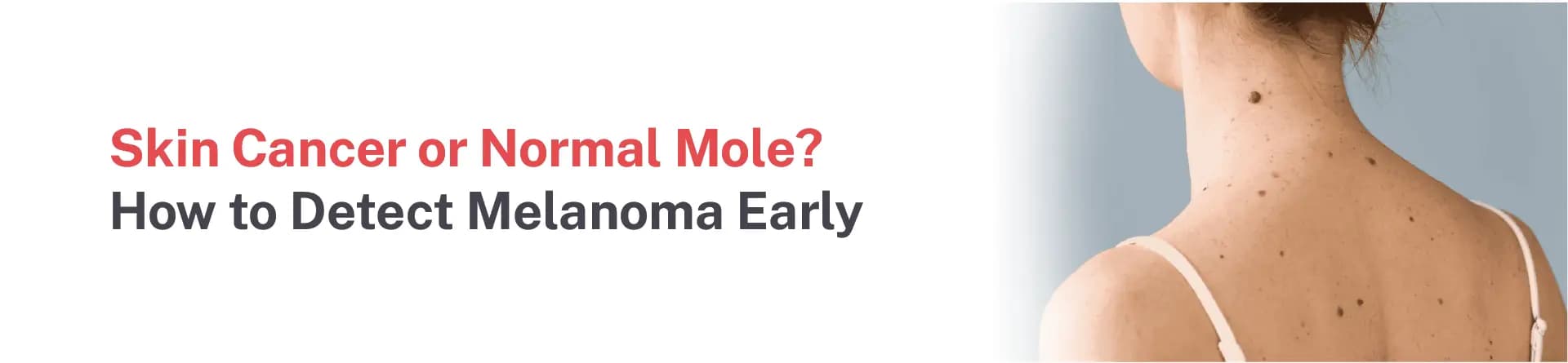
Most moles are harmless, but some changes may indicate melanoma, the most serious type of skin cancer. This blog explains how to differentiate a normal mole from melanoma using the ABCDE rule, common warning signs, and risk factors. Early detection plays a vital role in successful treatment. Know when it's time to consult a dermatologist for a skin examination.
In fact, only about 30% of melanomas develop from an existing mole, while the rest begin as a new growth. This is why it's important to watch for any new or changing spot on your skin. Knowing your risk can help you stay vigilant and seek a skin examination if you notice suspicious changes.
Melanoma has a 99% cure rate when detected in its earliest stage, making it one of the most treatable cancers when caught early. In this blog, you'll learn how to tell the difference between a normal mole and melanoma, the warning signs to watch for, and when to see a doctor.
Melanoma is a type of skin cancer that begins in melanocytes. These are the cells responsible for producing melanin, the pigment that gives your skin its colour.
Although melanoma is less common than other forms of skin cancer, it is much more aggressive. If it is not treated early, it can spread to nearby tissues, lymph nodes and other organs. This makes treatment more difficult.
When melanoma cancer is diagnosed in its early stage, it can often be removed completely with surgery. That is why doctors recommend checking your skin regularly and paying attention to any new or changing spots.
It is also important to know that melanoma does not always develop from an existing mole. Around 70% of melanomas develop as new spots on normal-looking skin, while about 30% develop from existing moles. This means you should keep an eye on your entire skin, not just the moles you already have.
Most normal skin moles are harmless. They usually appear during childhood or early adulthood and remain the same for many years.
A cancerous mole vs a normal mole often shows noticeable changes over time. It may become larger, develop uneven borders or have more than one colour. The table below explains the key differences.
|
Normal Mole |
Skin Cancer or Melanoma |
|
Round or oval in shape |
Irregular or uneven shape |
|
Smooth, well-defined border |
Jagged, blurred or uneven border |
|
One even shade of brown or tan |
Different shades of brown, black, red, white or blue |
|
Usually smaller than 6 mm |
May be larger than 6 mm but can also be smaller |
|
Stays the same over time |
Changes in size, shape, colour or texture |
|
Does not itch or bleed |
May itch, bleed, crust or become painful |
Recognising melanoma symptoms early can save your life. Melanoma often starts with small changes that are easy to overlook. Watch out for these skin cancer symptoms:
These warning signs do not always mean you have skin cancer, but they should never be ignored. Early diagnosis of melanoma significantly improves the chances of successful treatment.
It is important to remember that people with darker skin can also develop melanoma. In these individuals, it is more likely to appear on the palms of the hands, soles of the feet or under the nails. This is why everyone should perform regular skin checks, regardless of their skin colour.
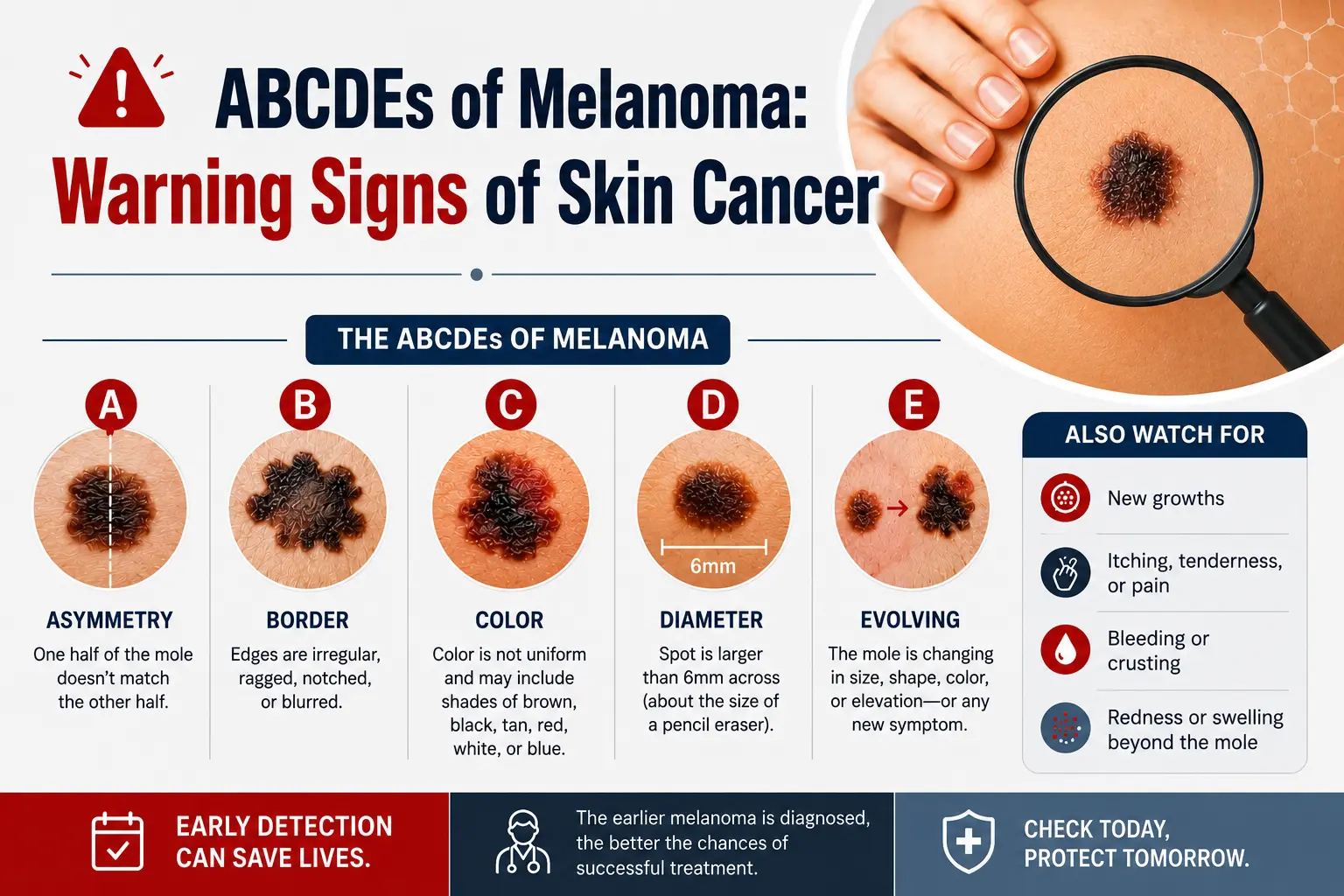
A healthy mole is usually symmetrical, meaning both halves look the same. If one half of the mole looks different from the other, it could be a warning sign.
Normal moles have smooth and clearly defined edges. A suspicious mole may have uneven, jagged, blurred or scalloped borders.
Most normal skin moles are a single shade of brown. A mole with different colours such as black, brown, red, white, blue or grey should be examined by a dermatologist.
Many people also ask, "Are white moles normal?" Some light-coloured or flesh-coloured moles can be harmless. However, a white spot or mole that changes in size, shape or colour, or develops itching or bleeding, should not be ignored.
A mole larger than 6 mm, about the size of a pencil eraser, deserves closer attention. However, it is important to remember that some early-stage skin cancer spots can be smaller than 6 mm. Size alone does not determine whether a mole is cancerous.
This is one of the most important warning signs. If a mole changes in size, shape, colour or texture, or starts itching, bleeding or crusting, it should be checked by a dermatologist as soon as possible.
Anyone can develop melanoma cancer, but certain factors increase the risk. You may be more likely to develop skin cancer if you:
It is important to remember that people with darker skin can also develop melanoma. In these individuals, it is more likely to appear on the palms of the hands, soles of the feet or under the nails. This is why everyone should perform regular skin checks, regardless of their skin colour.
Do not wait until a mole becomes painful or starts causing discomfort. Book an appointment with a dermatologist if you notice:
During your appointment, the dermatologist will carefully examine your skin. If a mole looks suspicious, they may recommend a skin biopsy. This is the only way to confirm whether the mole is cancerous.
Most normal moles are harmless and remain unchanged throughout life. However, it is important to remember that melanoma can sometimes look like an ordinary mole, especially in its early stages. It can also appear as a completely new spot on healthy-looking skin.
Learning the difference between a cancerous mole vs a normal mole and understanding the ABCDE rule can help you recognise the early signs of skin cancer. Regular self-examinations and prompt medical advice can make a significant difference.
If you notice unusual melanoma symptoms or any skin cancer symptoms, do not ignore them. Early diagnosis offers the best chance of successful melanoma treatment and can prevent the disease from spreading.
When it comes to skin cancer, checking a suspicious mole today could protect your health tomorrow.
A cancerous mole may change in size, shape or colour, have uneven borders, itch, bleed or look different from your other moles. The ABCDE rule can help identify suspicious changes.
Yes. Around 30% of melanomas develop from existing moles, while most develop as new spots on normal-looking skin.
No. Many dark moles are completely harmless. A mole should only be evaluated if it changes or shows warning signs such as irregular borders, multiple colours or bleeding.
Yes. Skin cancer can appear as a new spot or growth on the skin, which is why regular skin checks are important.
Yes. When melanoma is diagnosed and treated early, it can often be removed successfully before it spreads.
Yes. Although the risk increases with age, melanoma can also occur in younger adults and even teenagers.
Melanoma can spread to nearby tissues and other organs if left untreated, making early diagnosis and treatment essential.
Written and Verified by:

Dr. Adithi Jain is a Consultant in Dermatology Dept. at CK Birla Hospital, Jaipur, with over 5 years of experience. She specializes in dermatosurgery, aesthetic medicine, trichology, and paediatric dermatology.
Similar Dermatology Blogs
Book Your Appointment TODAY
© 2024 RBH Jaipur. All Rights Reserved.


