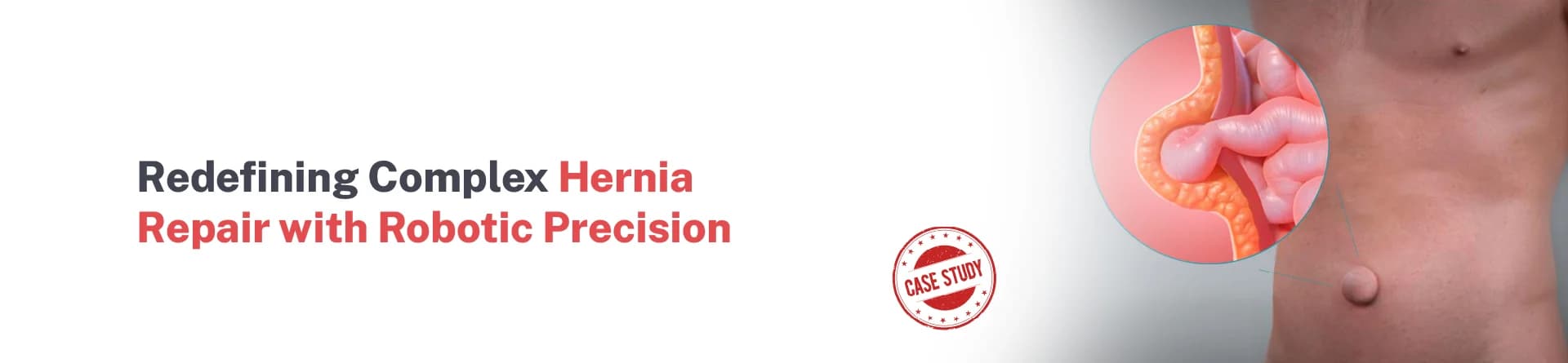
Redefining Complex Hernia Repair with Robotic Precision
Home >Case Study >Redefining Complex Hernia Repair with Robotic Precision

Redefining Complex Hernia Repair with Robotic Precision

Robotic Surgery |by Dr. Rajesh Sharma| Published on 09/01/2026

Rajasthan’s First Robotic eTEP-RS Repair Using Bioresorbable Mesh


Dr. Rajesh Sharma (Certified Advanced Robotic Surgeon)

Director – General Surgery, Minimal Access & Bariatric Surgery

CK Birla Hospitals, Jaipur

Professional Distinction

Dr. Rajesh Sharma is a pioneer in advanced minimally invasive and robotic surgery in Rajasthan, with multiple firsts to his credit:

  • First surgeon in Rajasthan appointed as a Robotic Surgery Proctor (da Vinci Surgical System)
  • Surgeon with the highest volume of robotic general surgeries in the state
  • First in Rajasthan to perform Single-Incision Laparoscopic Surgery (SILS)
  • First to perform TARM for hernia repair
  • First to perform robotic surgery/MICS using bioresorbable mesh

Clinical Case Study

Robotic Management of Complex Umbilical Hernia with Diastasis Recti

Patient Profile (Anonymised)


An adult patient presented with an irreducible umbilical hernia associated with diastasis recti. The patient had an incomplete family and expressed a desire for future pregnancies,  necessitating an abdominal wall reconstruction that was both durable and physiologically adaptable.

Case Overview


The patient had a complex ventral hernia compounded by diastasis recti, where long-term functional integrity of the abdominal wall was a critical consideration. A robotic-assisted approach was chosen to enable meticulous anatomical reconstruction, minimize tissue trauma, and facilitate optimal retromuscular mesh placement.

This case marks Rajasthan’s first minimally invasive robotic eTEP-RS procedure utilizing bioresorbable mesh.

Surgical Technique


Procedure Performed: Robotic eTEP-RS (Extended Totally Extraperitoneal – Retromuscular Sublay) repair.

A mesh, fully bioresorbable and resorbing over 15–18 months, was used.

The robotic platform enabled:

  • Precise dissection of tissue planes
  • Accurate midline reconstruction
  • Secure retromuscular placement of mesh
  • Enhanced visualization and superior suturing precision

Postoperative Outcome


The postoperative course was uneventful.

  • Minimal postoperative pain
  • No intra- or postoperative complications
  • Patient discharged within 38 hours
  • Favorable recovery and satisfactory progress on follow-up

Key Clinical Insights

  • Robotic eTEP-RS allows precise anatomical reconstruction in complex abdominal wall hernias
  • Bioresorbable mesh offers a significant advantage in carefully selected patients.
  • Robotic surgery enhances surgical precision, reduces postoperative pain, shortens hospital stay, and improves overall patient outcomes
NavBook Appt.WhatsappWhatsappCall Now