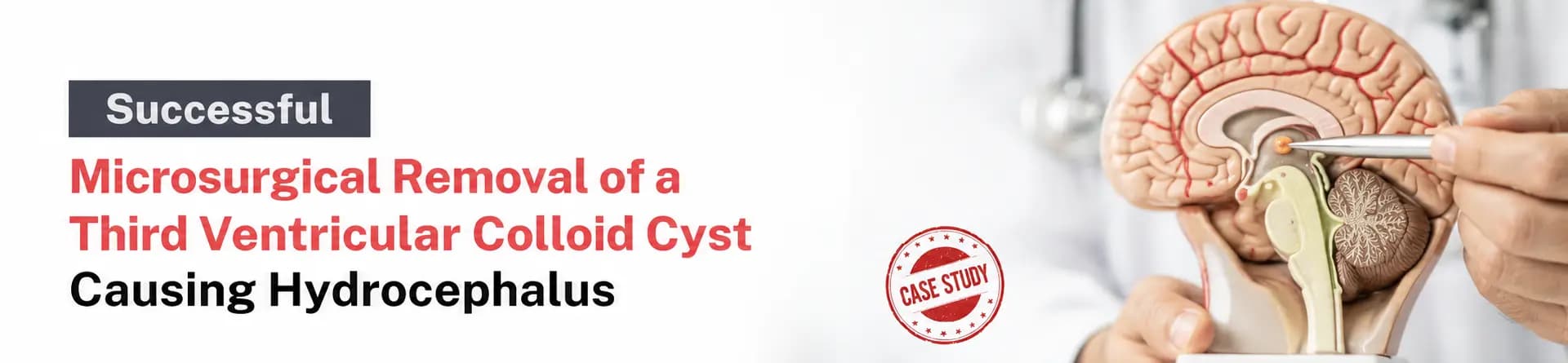
Successful Microsurgical Removal of a Third Ventricular Colloid Cyst Causing Hydrocephalus
Home >Case Study >Successful Microsurgical Removal of a Third Ventricular Colloid Cyst Causing Hydrocephalus

Successful Microsurgical Removal of a Third Ventricular Colloid Cyst Causing Hydrocephalus

Neurosciences |by Dr. Amit Chakrabarty| Published on 09/09/2026

Patient: XYZ

Clinical Diagnosis: Symptomatic Colloid Cyst of the Third Ventricle with Obstructive Hydrocephalus

Clinical Presentation:

Patient was evaluated for symptoms related to a colloid cyst of the third ventricle causing obstruction of cerebrospinal fluid (CSF) flow at the foramen of Monro.

Neuroimaging demonstrated a colloid cyst in close proximity to the foramen of Monro with associated obstructive hydrocephalus. Detailed assessment of the ventricular anatomy and relationship of the cyst with surrounding critical neural and vascular structures was performed to determine the safest surgical approach.

 Procedure Performed:

Microsurgical Excision of Third Ventricular Colloid Cyst through an Interhemispheric Transcallosal Approach comprising:

  • Interhemispheric transcallosal approach
  • Limited approximately 1 cm callosotomy
  • Entry into the right lateral ventricle
  • Microsurgical approach to the cyst at the foramen of Monro
  • Complete excision of the colloid cyst
  • Preservation of the fornix and deep venous structures
  • Restoration of CSF flow

Major Surgical and Perioperative Challenges:

  • Deep-seated location of the cyst within the third ventricular region.
  • Close proximity to the fornix, deep venous structures and other critical neural anatomy.
  • Obstruction of CSF circulation resulting in obstructive hydrocephalus.
  • Restricted surgical corridor requiring precise anatomical orientation.
  • Need for complete cyst removal while minimizing injury to surrounding critical structures.
  • Technical demands of microsurgical dissection within the ventricular system.
  • Careful approach selection based on ventricular anatomy and cyst characteristics.

Outcome:

  • Successful microsurgical excision of the colloid cyst achieved.
  • Obstruction to CSF circulation was relieved.
  • Critical surrounding neural and vascular structures were preserved.
  • Patient had a satisfactory postoperative recovery.
  • No new postoperative neurological deficit was observed.

Clinical Significance:

This case highlights that although a colloid cyst is benign by pathology, its strategic location can make it a significant neurosurgical challenge. Both endoscopic and microsurgical techniques have an important role in management, with the approach individualized according to cyst characteristics, ventricular anatomy and surgical expertise.

Precise anatomical knowledge, appropriate approach selection and meticulous microsurgical technique remain fundamental to achieving safe and durable outcomes in complex neurosurgery.

Patient-identifying information has been withheld to maintain confidentiality.

NavBook Appt.WhatsappWhatsappCall Now