
Surgery is an important part of treatment for many cancers. Depending on the type and location of the tumour, surgery may be performed through an open approach or using minimally invasive techniques such as laparoscopy. These advances have made it possible to treat some cancers through smaller incisions while reducing the impact of surgery on the body.
Robotic cancer surgery is an advanced form of minimally invasive surgery. It gives the surgeon a high-definition 3D view of the surgical area and allows precise, controlled movements using specialised instruments. This can make it easier to perform certain complex procedures through small incisions and may offer benefits such as less blood loss, less scarring and faster recovery in selected patients.
At the CK Birla Hospitals, Kolkata, our cancer specialists evaluate your cancer type, stage, tumour location and overall health to determine whether robotic surgery is an appropriate option for your treatment.
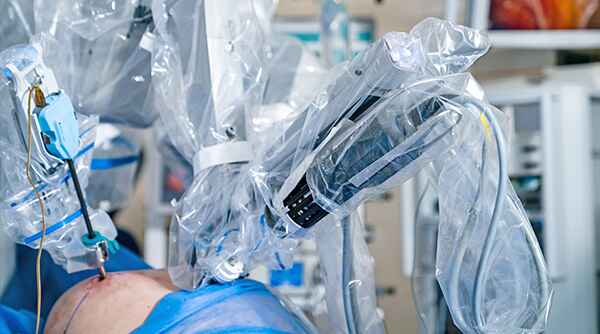
Robotic cancer surgery is a minimally invasive approach used to remove cancerous tumours through small incisions. It uses a robotic surgical system with a high-definition 3D camera and specialised instruments. The system helps the surgeon view the surgical area clearly and make precise, controlled movements during the procedure.
Robotic surgery does not mean that a robot performs the operation independently. The surgeon controls the robotic system and remains in control throughout the procedure.
The procedure generally involves the following steps:
Robotic surgery can be used for several types of cancer. It may be considered when the tumour can be safely removed using a minimally invasive approach.
Some cancers that may be treated with robotic surgery include:
Not every patient with these cancers needs robotic surgery. Your cancer type, tumour size and location, cancer stage and overall health help determine whether robotic surgery is suitable for you.
Robotic surgery for cancer can offer some benefits compared with traditional open surgery in selected patients. These may include:
Cancer surgery can be performed using different surgical approaches. The choice depends on the type and location of the tumour, cancer stage, the complexity of the procedure and the patient's overall health.
|
Feature |
Open surgery |
Laparoscopic surgery |
Robotic surgery |
|
Incisions |
Usually one larger incision |
Several small incisions |
Several small incisions |
|
How the surgeon operates |
Directly through the surgical opening |
Uses long, specialised instruments |
Controls robotic instruments from a console |
|
View of the surgical area |
Direct view |
Camera-based 2D or 3D view, depending on the system |
High-definition 3D view |
|
Instrument movement |
Conventional surgical instruments |
Straight, specialised instruments |
Robotic instruments with greater range of movement |
|
Surgeon control |
Directly controls the instruments |
Directly controls the instruments |
Directly controls the robotic instruments |
|
Typical use |
May be used when a larger access area is needed |
Used for many procedures that can be performed minimally invasively |
May be considered for selected procedures, including some complex cancer surgeries |
Robotic cancer surgery may be considered when a tumour can be safely removed through a minimally invasive approach. However, it is not suitable for every patient. The decision depends on the type of cancer, the location and extent of the tumour, and your overall health.
Your cancer specialist may consider:
Before recommending robotic cancer surgery, your surgeon will carry out a detailed evaluation. This may include a physical examination, imaging tests, blood tests and other assessments based on your cancer and treatment needs.
At the CK Birla Hospitals, Kolkata, we use a team-based approach to cancer care, with specialists working together to plan treatment based on your individual needs.
Our robotic-assisted surgical capabilities allow surgeons to perform selected cancer procedures using advanced robotic technology. The system provides high-definition 3D visualisation and specialised instruments that support precise and controlled movements during surgery. The surgeon remains in control of the procedure throughout.
Our cancer specialists assess factors such as the type and stage of cancer, tumour location, size and your overall health before deciding whether robotic surgery is suitable for you. When required, specialists from different areas of cancer care work together to plan surgery as part of your overall treatment.
The focus is not simply on using robotic technology. It is on choosing the surgical approach that is appropriate for your cancer and providing safe, comprehensive care.
Robotic surgery is not always better than open surgery. Both approaches have a role in cancer treatment. Robotic surgery may offer smaller incisions, less pain and faster recovery for some patients. Open surgery may be more suitable for certain large or complex tumours. Your surgeon will recommend the approach based on your condition.
Robotic surgery can be used for selected prostate, colorectal, colon, rectal, stomach, oesophageal, pancreatic, liver, lung and gynaecological cancers. Whether it is suitable depends on the cancer and the individual patient.
Robotic surgery itself does not guarantee a lower risk of cancer recurrence. The risk depends on factors such as the type and stage of cancer, tumour characteristics and whether the cancer has been completely removed. Robotic surgery is a method of performing the operation, not a separate cancer treatment.
It can cause less pain for some patients because the surgery is usually performed through smaller incisions. However, pain varies from person to person and depends on the type of operation.
Yes. Robotic cancer surgery has risks, like other types of surgery. These may include bleeding, infection, blood clots and injury to nearby organs or tissues. In some cases, the surgeon may need to change to open surgery during the procedure. Your doctor will explain the possible risks before surgery.
© 2024 CMRI Kolkata. All Rights Reserved.


